
In many organizations, automation is still understood as a way to eliminate manual work or digitize existing processes.
Forms become systems. Tasks become workflows. Speed improves—but decision quality often remains unchanged.
With the rise of artificial intelligence, this understanding is no longer sufficient.
Today, the real question is not what can be automated, but rather:
Which decisions, patterns, and recurring judgments can be intelligently supported—without weakening human roles or organizational learning?
This article explores how organizations can design AI-driven automation as a gradual, low-risk, and value-creating transformation. Using TRIZ principles, we outline practical steps and golden insights to help leaders move beyond cost reduction toward innovation-driven automation.
1. What Is AI Automation—and How Is It Different from Traditional Digitalization?
Traditional Digitalization
In classic digital transformation:
- Existing processes are digitized with minimal redesign
- Systems execute predefined instructions
- Decision-making remains fully human
Examples include:
- Converting paper forms into online forms
- Replacing manual reporting with dashboards
The main benefit is operational efficiency.
AI-Driven Automation
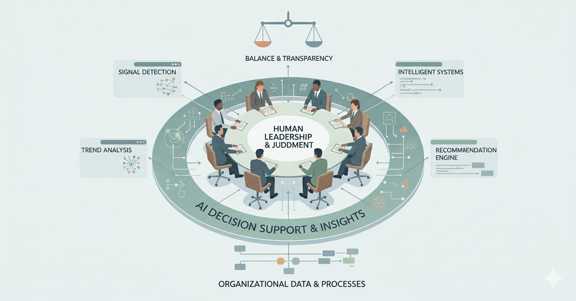
AI automation introduces a fundamentally different capability:
- Systems analyze, recommend, and anticipate
- The focus shifts to decision-making support, not task execution
- Systems learn and improve over time
Examples include:
- AI systems prioritizing decisions or cases
- Predictive models highlighting risk, opportunity, or anomalies
Key difference:
Digitalization improves speed.
AI automation improves decision quality and innovation capacity.
2. Operational Steps for Implementing Smart Automation
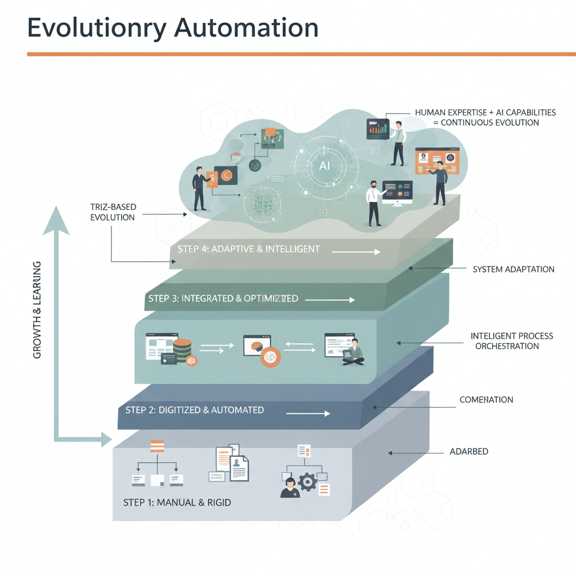
Effective AI automation should never be sudden or organization-wide.
The most resilient approach is gradual, modular, and learning-driven.
Step 1: Process and Decision Analysis
The goal at this stage is not automation—it is understanding decisions.
Key questions:
- Where are repetitive decisions being made?
- Which decisions are data-driven?
- Where do delays, inconsistencies, or human error occur?
Output:
- A map of decision points
- Identification of processes suitable for decision-support automation
Step 2: Define the Level of Automation
Not every decision should be automated.
Practical levels include:
- Decision Support: AI provides insights; humans decide
- Decision Recommendation: AI ranks or prioritizes options
- Conditional Automation: Decisions are automated under predefined conditions
📌 Golden rule:
Successful automation starts with decision support, not replacement.
Step 3: Design the Intelligent System
At this stage, AI is designed as a decision-support agent.
Core design elements:
- Inputs (data, signals, constraints)
- Analytical logic
- Outputs (recommendations, alerts, forecasts)
🎯 Focus on:
Transparency and explainability—not technical complexity.
Step 4: Controlled Testing and Organizational Learning
The system is deployed in a controlled environment:
- Alongside human decision-makers
- Without full authority
- With continuous feedback
📈 Objectives:
- System learning
- Organizational learning
- Role clarification and refinement
Step 5: Optimization and Scaling
Once value is validated:
- Decision scope expands
- Automation becomes adaptive
- Learning loops remain active
AI automation becomes an evolving capability—not a static tool.
3. Applying TRIZ Principles to Design Innovation Automation
TRIZ thinking helps organizations avoid imitation, stagnation, and unintended consequences.
It enables automation systems to evolve rather than disrupt.
Principle 1: Eliminate the Intermediary
Instead of adding control layers:
- AI delivers insights directly to decision-makers
- Manual reporting and unnecessary handoffs are removed
Result: Faster, clearer decisions.
Principle 2: Function Integration
Rather than multiple fragmented tools, one system:
- Analyzes data
- Detects patterns
- Recommends actions
Result: Integrated, coherent decision-making.
Principle 3: Self-Service Systems
Systems should be designed so that:
- Non-technical users can interact independently
- Decision-makers can explore scenarios without technical mediation
Result: Higher adoption and trust.
Principle 4: Anticipation
AI should not only describe the present, but also:
- Identify trends
- Flag emerging risks
- Highlight potential opportunities
Result: Proactive rather than reactive decisions.
Principle 5: Self-Evolution
The system:
- Learns from human feedback
- Refines its logic
- Improves decision support over time
📌 This principle is the core of sustainable AI automation.
4. Golden Success Factors in AI Automation
1. Manage Change, Not Just the Project
Resistance is rarely technical—it is human.
Roles must be redesigned, not erased.
2. Train Decision-Makers, Not Just Users
AI is a decision partner, not a black box.
Leaders must understand its logic and limitations.
3. Align Automation with Business Strategy
Automation that only reduces cost delivers short-term gains.
Automation that improves decisions creates long-term competitive advantage.
4. Start Small, Think Systemically
Innovation automation begins with one process—but evolves into an organizational capability.

Conclusion: From Efficiency to Innovation
When designed intentionally, AI automation does not replace people.
It strengthens judgment, accelerates learning, and expands innovation capacity.
By combining:
- Clear operational steps
- TRIZ-based innovation principles
- A focus on decision-making support
organizations can move beyond efficiency toward sustainable, innovation-driven transformation.
AI, in this context, is not a shortcut—it is a carefully designed evolutionary force.